
Home / H₂S removal
Gas cleaning · biological desulphurisation
Microaeration: remove H₂S inside the digester
Hydrogen sulphide corrodes engines, boilers and pipes, poisons upgrading media and smells. Microaeration removes most of it where it forms, before the gas leaves the digester, without chemicals.
At a glance
| Removal | up to 99 % H₂S |
| Inlet tested | 4,000 mg/m³ H₂S |
| Product | >98 % ends up as elemental sulphur |
| Chemicals | none, no special bacteria, no pH control |
Just enough oxygen, never too much
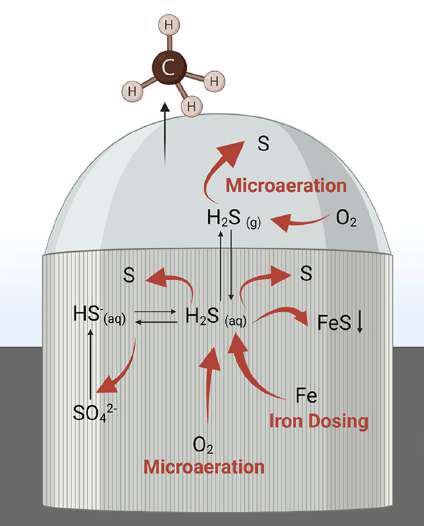
A controlled trace of air or oxygen goes into the digester. Bacteria that are already there use it to turn H₂S into elemental sulphur, which settles on surfaces and leaves with the digestate.
The dose is too small to disturb the methane-forming bacteria. Online measurement of H₂S and O₂ in the biogas controls the dosing, keeps oxygen well below the safety limits and prevents over-aeration. Where needed, we combine it with iron dosing in the digester.
What it achieves
99 %H₂S removal efficiency
4,000 mg/m³initial H₂S concentration handled
>98 %of the removed sulphide recovered as sulphur
0chemicals, inoculum, nutrients or pH control
Cleaner gas protects the whole plant
- Longer engine life, fewer oil changes
- Smaller carbon filter or scrubber before upgrading
- Less SOₓ in the exhaust
- Less corrosion in digester roof, pipes and boilers
- Less odour around the plant
- Easy to retrofit
High H₂S in your biogas?
Send us your gas analysis and gas flow. We size the microaeration system.
Helpful for a first assessment
- Type and size of the plant: biogas, BioCNG or wastewater; m³, t/day or kW
- Substrates: type, quantity per day, dry matter if known
- What bothers you today: gas yield, H₂S, mixing, sludge volume
- A few photos of the site, if you have them