
Straw briquettes: crop residue as biogas feed
India burns millions of tonnes of paddy straw in the fields every year. Kinetic Biofuel, part of the Danish press manufacturer C.F. Nielsen, has a mechanical process that turns this straw into a high-yield feed for biogas and BioCNG plants.
At a glance
| Methane | ≈250 Nm³ CH₄ per tonne straw, up to ≈300 with catalyst |
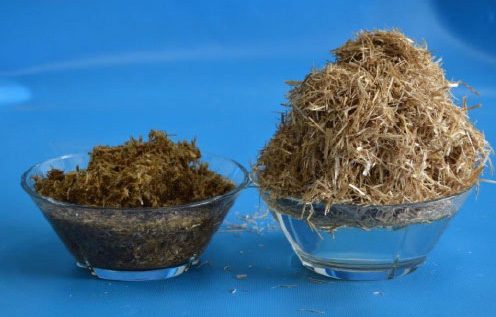
| Absorption | 10–12× its own weight, briquettes sink |
| Press energy | ≈75 kWh per tonne, recovered as heat |
| Presses | three sizes, 0.6 to 2.8 t/h |
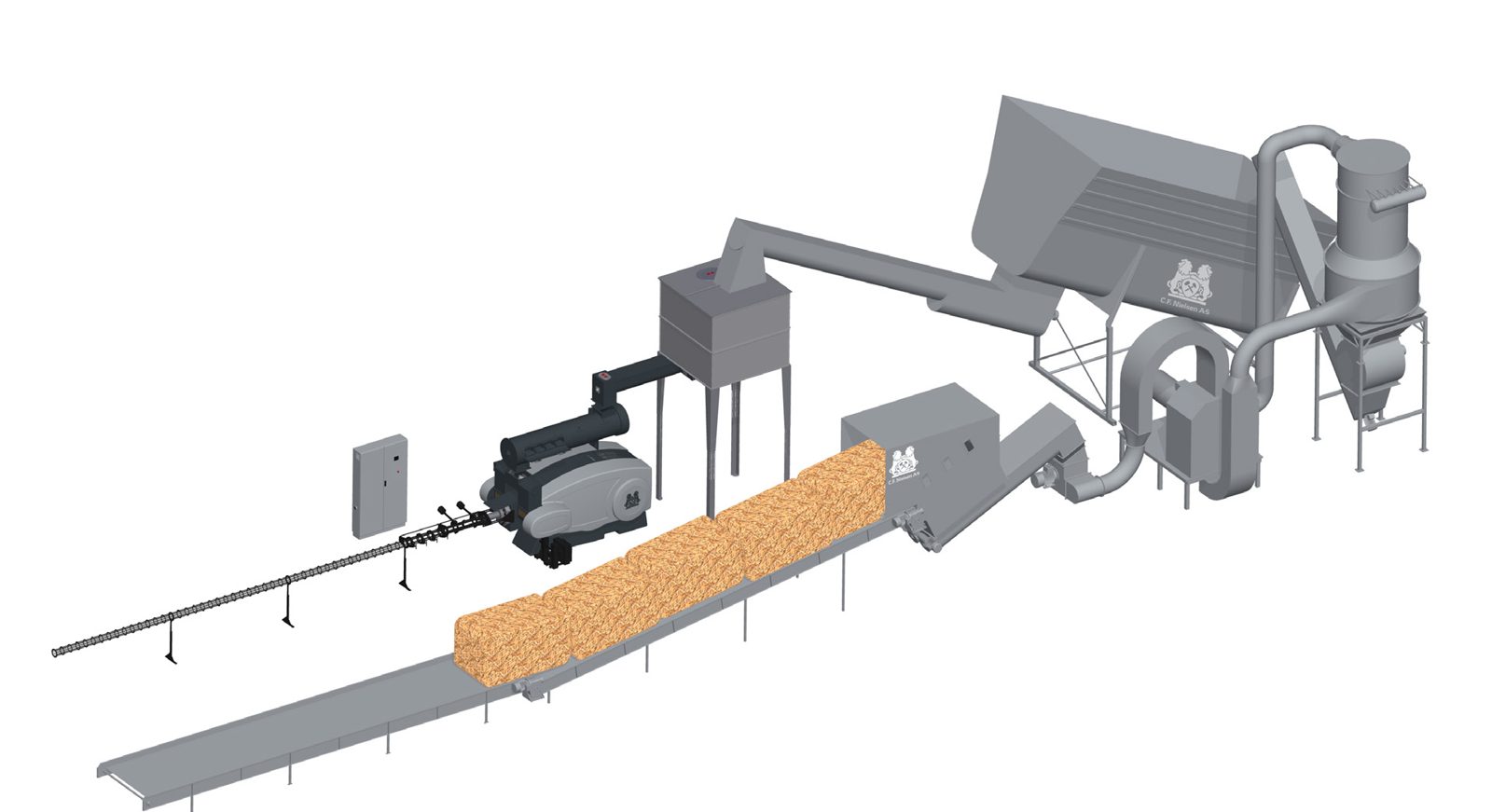
Compression and pre-treatment in one step
An eccentric press forces straw through a conical die. Pressure and friction open up the straw, so water, microorganisms and enzymes reach the fibres. No steam, no chemicals, no water.
Bales
Straw bales are opened and fed to the straw line.
Cleaning
Stones, soil and sand are removed, which protects the press and the digester.
Briquetting
The press compresses and pre-treats the straw; little air stays in the briquette.
Feeding
Briquettes go into the digester by screw feeder or through a mixer tank.
- Soaked briquettes reach the density of water: no floating covers, no sediment
- No extra slurry or tanks, so the plant’s hydraulic capacity stays free
- Press energy comes back as process heat when the press stands at the plant
- Less nitrogen and oxygen in the biogas, which helps BioCNG upgrading
- Helps against ammonia inhibition; allows co-digestion with poultry manure
- Run for more than three years at Aarhus University’s Foulum test facility
How straw pre-treatment compares
| Pre-treatment | Methane yield (Nm³/t straw) | Max. straw in slurry | Extra methane per t slurry |
|---|---|---|---|
| Shredded straw | 200 | 1–2 % | 10–20 Nm³ |
| Other mechanical processing | 225 | 2–6 % | 27.5–67.5 Nm³ |
| Briquetted straw | 250 | 8–12 % | 100–150 Nm³ |
| Briquetted with catalyst | 300 | 10–12 % | 150–180 Nm³ |
In practice: at Farm Renewables on the Isle of Sheppey (UK), straw briquettes deliver nearly half of the plant’s biogas.
Manufacturer figures, Kinetic Biofuel / C.F. Nielsen.
Three press sizes
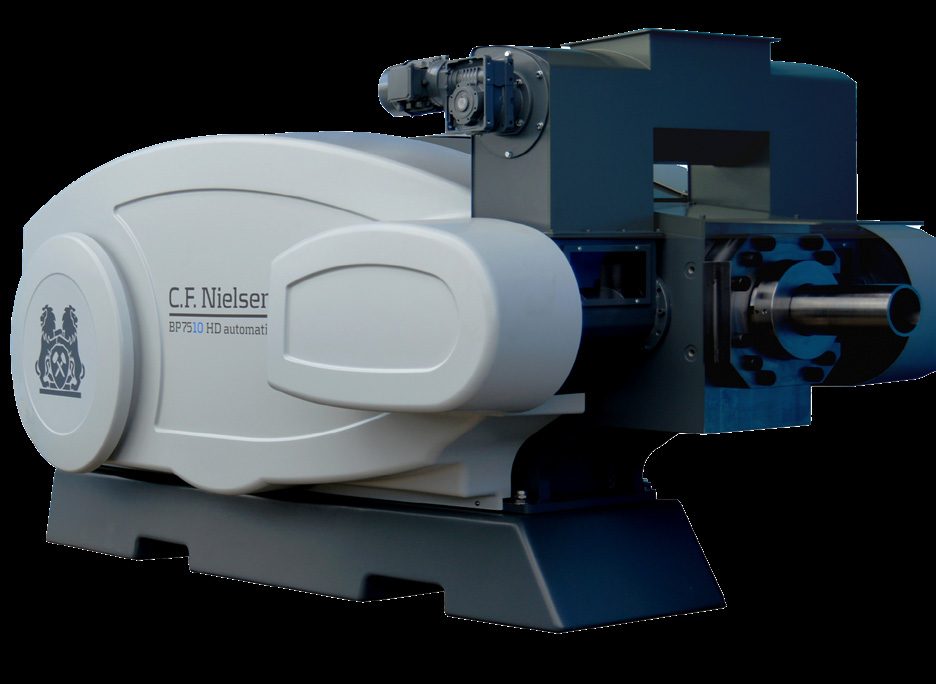
Eccentric presses from C.F. Nielsen. Capacity depends on the straw and on how hard the briquettes are made: at the biogas plant they can be looser (more throughput), for transport they are pressed harder.
Data sheet BP 7010 / 7510 (PDF)
| Model | Capacity | Typical use |
|---|---|---|
| BP 4000 | 0.6–0.7 t/h | Smaller plants |
| BP 6510 | 1.4–1.7 t/h | Most common model |
| BP 7510 | 2.2–2.8 t/h | High-capacity lines |
Press at the biogas plant, or where the straw is
At the biogas plant
Looser briquettes, more throughput, no briquette storage. They go straight into the digester by chain conveyor and screw feeder, or are stirred into slurry in a mixer tank and pumped.
At the farm or collection point
Harder briquettes for transport and storage. One line can supply one or several biogas plants and moves far less volume than loose bales.
References and test results
| Where | What | Result |
|---|---|---|
| Farm Renewables, Isle of Sheppey, UK | Biogas plant fed with Kinetic Biofuel straw briquettes | Straw briquettes provide nearly 50 % of the total biogas output |
| Aarhus University, Foulum, Denmark | Full-scale research biogas plant, demonstration of briquetted straw and dry grass | More than three years of operation with straw briquettes |
| C.F. Nielsen, Denmark | Manufacturer of the presses, founded 1889 | More than 1,000 briquetting installations for wood waste and other biomass worldwide |
Sources: kineticbiofuel.com and Kinetic Biofuel brochure.
From stubble burning to BioCNG
Paddy straw is plentiful and cheap, and today most of it is burnt. Briquetting turns it into a dependable feed for CBG plants under the SATAT programme, and for existing plants that want to grow without more manure or food waste.
- Feasibility study with your straw and your plant data
- Supply, installation and commissioning by Bert Energy India
- Service and spare parts from India, backed by the manufacturer
Do you have straw nearby?
Tell us about your plant and the straw you can get. We work out the potential with Kinetic Biofuel.
Helpful for a first assessment
- Type and size of the plant: biogas, BioCNG or wastewater; m³, t/day or kW
- Substrates: type, quantity per day, dry matter if known
- What bothers you today: gas yield, H₂S, mixing, sludge volume
- A few photos of the site, if you have them